


The Stars Beyond Ithaca: What Homer Knew About Space Exploration
By Dimitrios Thomakos
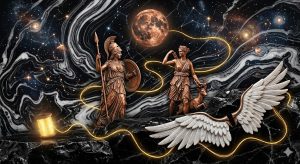
What would the ancient Greeks have to say about humanity's return to the Moon? More than you might expect — and far more than NASA's naming committees apparently considered. A new CAIL monograph argues that Homer's Odyssey is, beneath its surface narrative of Mediterranean wandering, a remarkably precise proto-cosmological allegory: each of Odysseus's encounters — the Cyclops, the Land of the Dead, Circe's island, the seduction of Calypso — encodes a distinct challenge of alien-world exploration that modern astronauts and mission planners would recognize immediately. The polytropos, the man of many turnings, is not merely a clever hero; he is the epistemological ideal of the deep-space explorer: adaptive, identity-preserving, and guided by nous rather than brute force. And his guardian is not Artemis — a goddess of forests and hunt, a poor choice for a lunar program — but Athena, born of pure intelligence, patron of technê at its highest, and the divine figure who ensures the explorer's return.
The mythological complex of Daedalus, Icarus, and Ariadne completes the picture. Daedalus is the first portrait in Western literature of the morally neutral technician — a Demiurge whose creations serve both liberation and catastrophe, a figure whose structural position is occupied today by the builders of large language models and autonomous spacecraft alike. Icarus is not a warning against ambition but against phronesis abandoned: the same wings, the same sky, a different altitude chosen in the mind before it is chosen in the air. And Ariadne's thread — the mîtos — is the most profound metaphor the classical world offers for what technological civilization currently risks losing: the unbroken connection to origin, community, and self that makes return not just possible but meaningful. At a moment when the world is simultaneously racing toward artificial general intelligence and back to the Moon, the Delphic oracle's two maxims — know thyself and nothing in excess — are not ornamental wisdom. They are the only rational launch checklist we have. The full monograph is available for download below.
